
AP-085 · LITERATURE
Malcolm X (Detroit Red)
The Autobiography's hustler chapters are a literary self-portrait; the biographers agree they are shaped, and disagree on which way.
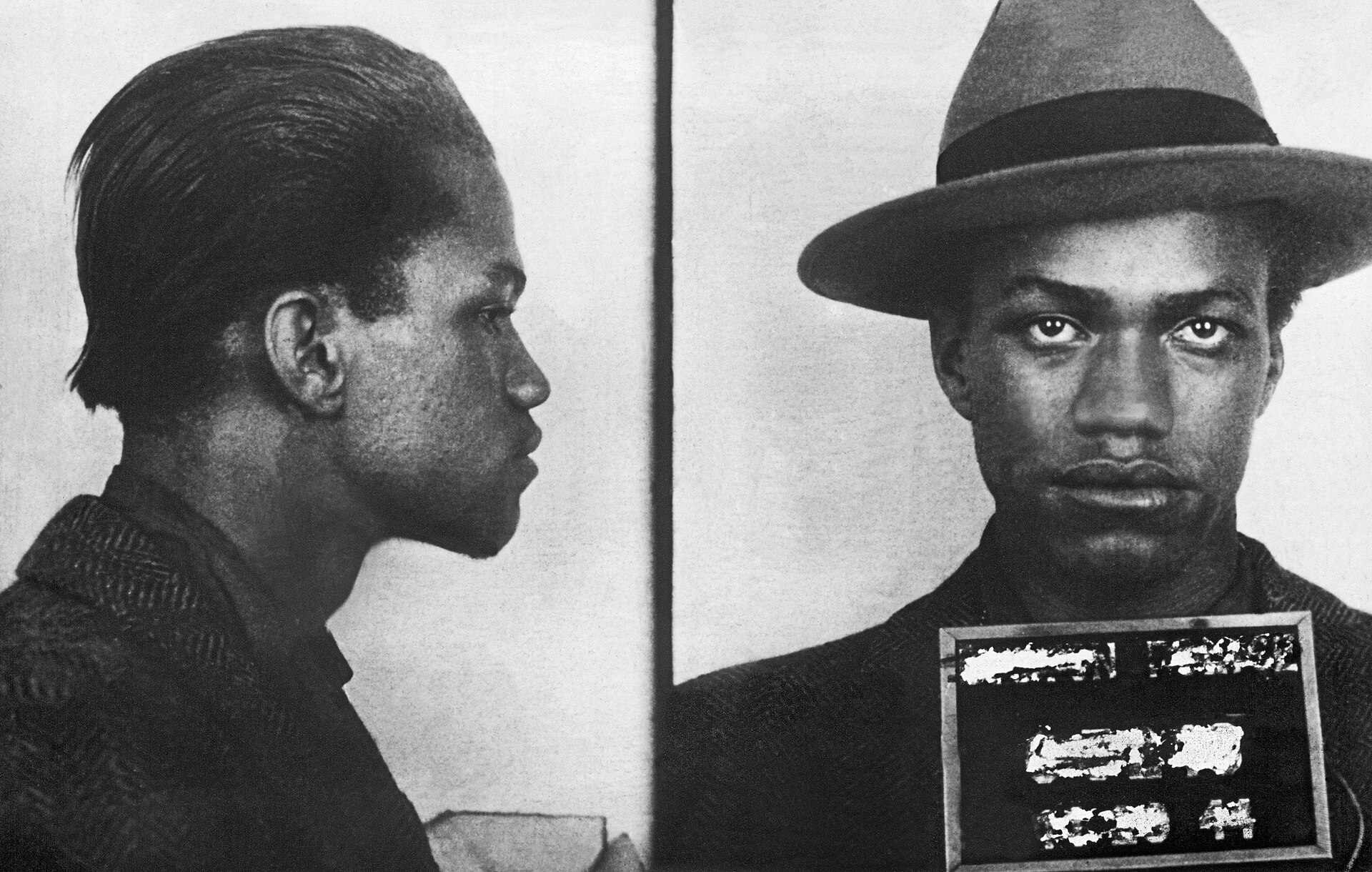
Boston Police Department mugshot, 1944. Public domain, via Wikimedia Commons.
The Autobiography of Malcolm X (Grove Press, 1965), written with Alex Haley from interviews conducted between 1963 and Malcolm's assassination, gives several chapters to the years he spent as "Detroit Red" in Boston and Harlem, roughly 1940 to 1946. In them he describes shining shoes at the Roseland ballroom, waiting tables at Small's Paradise, selling reefer to musicians, running numbers, steering white customers to Harlem's sex trade, armed robbery, and a Boston burglary ring with his white girlfriend "Sophia" that ended in his 1946 arrest and a prison sentence. Two figures from the trade are named as friends and teachers: "Sammy the Pimp" and the numbers banker West Indian Archie. The book does not say Malcolm managed women himself; it says he steered, hustled and lived among pimps, and it renders that life as a descent that only prison and the Nation of Islam reversed. That arc is the point of the chapters, and it is why they matter to this archive: they are the most widely read first-person account of the hustler's Harlem, and they were written to be repented of.
Get The Autobiography of Malcolm X on Amazon →
As an Amazon Associate, American Pimp earns from qualifying purchases.
Manning Marable's Malcolm X: A Life of Reinvention (Viking, 2011), published three days after Marable's death and awarded the 2012 Pulitzer Prize for History, argued that the self-portrait was inflated. Drawing on FBI files, prison and court records and interviews, Marable concluded that Malcolm "purposely exaggerated his criminal exploits," partly to dramatise his conversion. The reality, in Marable's reading, was more modest: railroad sandwich sales ("Sandwich Red"), small-scale marijuana dealing, "largely amateurish holdups," and the 1946 burglaries, after which Malcolm informed on his associates and still drew an eight-to-ten-year sentence. Marable also suggested, on evidence he called circumstantial, that Malcolm had a paid sexual relationship with an older white Boston man. Researcher Zaheer Ali, who worked on the project, put the thesis in a sentence on NPR: "He was not really that hardcore of a hustler."
The book was attacked as well as praised. On Democracy Now! in May 2011 Amiri Baraka objected that its controversial claims rested on "FBI, CIA, New York Police" sources, and Herb Boyd challenged the sexual allegations as lacking credible witnesses, while Michael Eric Dyson defended it as "exhaustive factual analysis"; a 2012 essay collection, A Lie of Reinvention, accused Marable of "speculation and salacious innuendo." Les Payne and Tamara Payne's The Dead Are Arising (Liveright, 2020) then pushed in the other direction on the early years, presenting Malcolm as "a seasoned initiate in the hustler's life" whose experiences were, in the reviewer Peniel Joseph's summary, "even more lurid than recounted in the autobiography," including theft from his own mother as a boy.
What the scholarship agrees on is narrower than either camp's headline. The hustling, the numbers, the reefer, the steering and the 1946 burglary conviction are documented. The Autobiography is a collaboration whose shape, Marable showed, owed much to Haley, who cut three chapters of Malcolm's late political thinking. Whether Malcolm's Harlem was tamer or wilder than he told it, the book remains a made object: a conversion narrative in which the hustler had to be large enough to be worth saving.
ALSO KNOWN AS
Malcolm Little; later El-Hajj Malik El-Shabazz
BORN
Omaha, Nebraska, 19 May 1925
STATUS
Died 21 February 1965, New York City, aged 39
ERA
1940–1946 (the years described); 1965–2020 (the books)
ASSOCIATED WITH
Roxbury, Boston; Harlem; Small's Paradise; Alex Haley; Manning Marable; Les Payne
STANDING
Documented
DOCUMENTED RECORD
- 1946 — Malcolm Little arrested in Boston for burglary with an interracial crew; sentenced to eight to ten years (Marable, per Chronicle of Higher Education review).
- 1965 — The Autobiography of Malcolm X, as told to Alex Haley, published by Grove Press after Malcolm's assassination on 21 February 1965.
- 1 April 2011 — Manning Marable dies of pneumonia complications in Manhattan, aged 60 (Associated Press / Washington Post).
- 4 April 2011 — Malcolm X: A Life of Reinvention published by Viking.
- 19 May 2011 — Democracy Now! roundtable with Amiri Baraka, Herb Boyd and Michael Eric Dyson on the book's claims.
- 2012 — Marable's biography awarded the Pulitzer Prize for History.
- 2020 — Les Payne and Tamara Payne's The Dead Are Arising published by Liveright.
NOT ESTABLISHED
- Marable's suggestion of a paid sexual relationship with a white Boston man is, by his own description, circumstantial; Herb Boyd and others dispute the sourcing.
- The extent of Malcolm's involvement in the sex trade beyond steering is not settled: the Autobiography does not describe him managing women, Marable minimises the whole period, and Payne enlarges it.
- How far Haley's editorial hand shaped the hustler chapters, as opposed to the political ones he cut, is argued rather than shown.
- Dialogue and named episodes in the Autobiography (for example scenes with Sammy the Pimp) are recollection rendered as narrative, not contemporaneous record.
FOOTAGE
Michael Eric Dyson on Democracy Now! About Marable's Biography, Malcolm X: A Life of Reinvention — mediagrrl9
Herb Boyd on Democracy Now! About Marable's Biography, Malcolm X: A Life of Reinvention — mediagrrl9
Manning Marable Interviewed on Democracy Now! About His Research on Malcolm X in 2005 & 2007. 2 of 2 — mediagrrl9
Video title — Channel
Video title — Channel
Video title — Channel
SOURCES
- Rescuing Malcolm X From His Calculated Myths — Peniel E. Joseph, The Chronicle of Higher Education (1 May 2011)
- Manning Marable, Malcolm X: A Life of Reinvention — The Pulitzer Prizes (2012, History)
- Manning Marable's Controversial New Biography Refuels Debate on Life and Legacy of Malcolm X — Democracy Now! (19 May 2011)
- Barbershop: Marable's Malcolm X — NPR Tell Me More (2011)
- Harlem's Hero Revisited — Peniel E. Joseph, Los Angeles Review of Books (18 January 2021)
- Manning Marable, author of long-awaited Malcolm X biography, dies at 60 — The Washington Post / AP